Every analytical product carries the biases of its framework. Most intelligence products use one lens and present it as objectivity. For Global Race Condition, we use multiple lenses deliberately, name them explicitly, and let the reader see which frameworks are driving which conclusions.
Two types of lenses work together. Overlay frameworks are like decoder rings that apply to any story in any region, and decode behavioral patterns. Actor lenses are perspective lenses organized into six theaters defined by strategic relationships, not just map lines. Actor lenses answer 'how does this actor see the world, and what do they want?'
When independent lenses converge on the same conclusion, confidence goes up. When they diverge, that divergence is often even more valuable. The reader does not need to adopt any single framework; they only need to see what each framework reveals that the others miss.
These five frameworks apply across all stories regardless of region. Each decodes a different type of behavior pattern that conventional analysis tends to miss.
Aleksandr Dugin's "Foundations of Geopolitics" (1997) has been taught at Russia's General Staff Academy for over two decades. It is the published doctrinal framework for Russian military and intelligence leadership. The core thesis: history is a permanent contest between continental land powers and maritime coastal powers. Russia must consolidate Eurasian control and fragment the US-led Atlantic bloc.
The book contains specific, region-by-region prescriptions: what to do with Ukraine, the Baltics, Turkey, China, and how to destabilize the United States internally. These prescriptions are checkable against observed behavior, which makes the framework analytically useful regardless of whether any given Russian official has read the book.
What it reveals that other frameworks miss: actions that appear opportunistic or reactive through a conventional lens sometimes map precisely to a published strategic playbook. When Russian behavior matches a Dugin prescription, our analysis tends to shift from "why did they do that?" to "what does the playbook say they do next?"
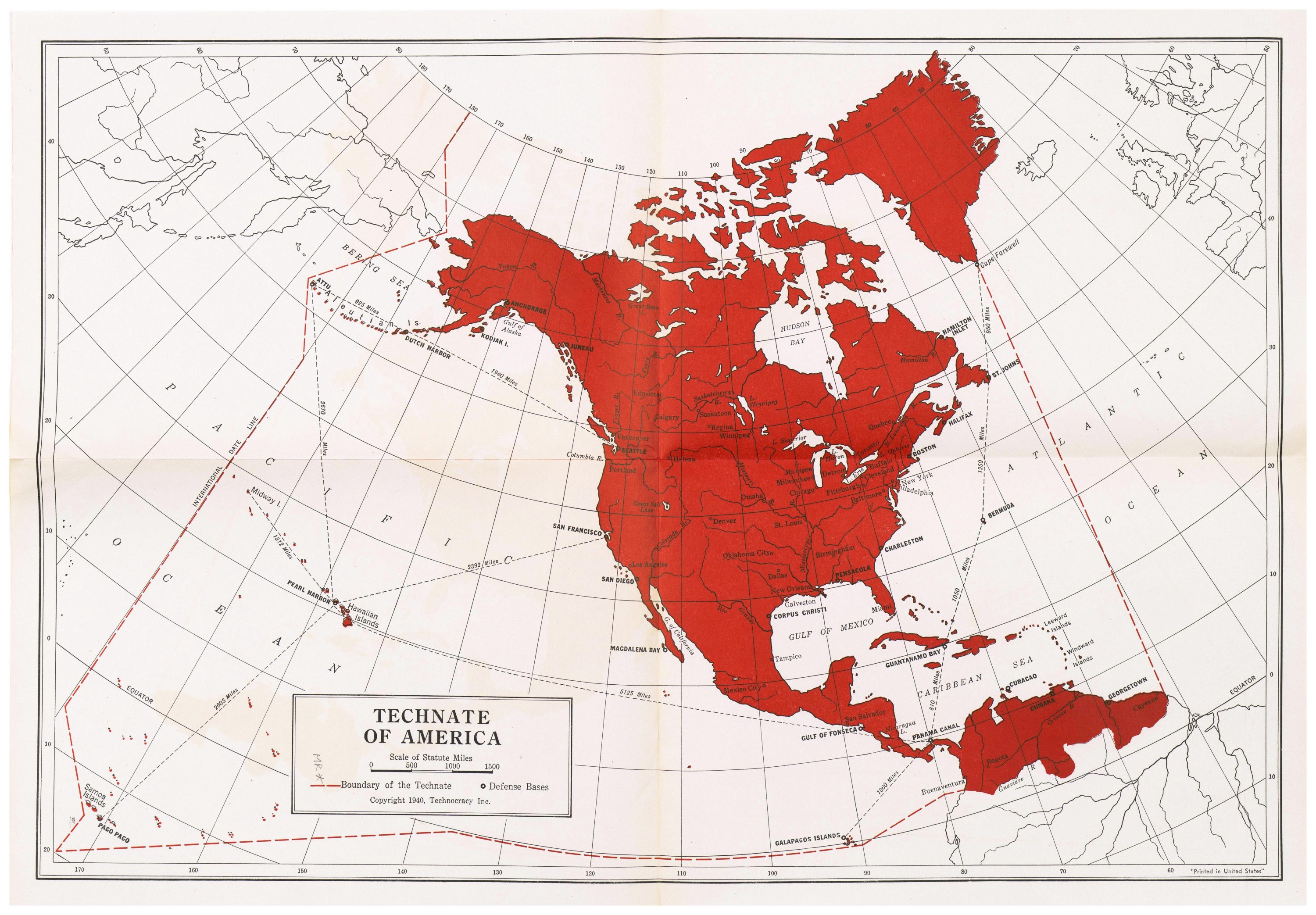
Technocracy is not new. The idea that governance should be managed by technical experts rather than elected politicians has been an active intellectual movement for over a century. In 1919, Howard Scott founded the Technical Alliance in New York. By 1932, Scott and Columbia University professor Walter Rautenstrauch had formed the Committee on Technocracy at Columbia, generating national press coverage and mass public interest during the depths of the Depression. M. King Hubbert, the geophysicist who later developed "peak oil" theory, served as co-author of the movement's foundational text, the Technocracy Study Course (1934).
The core proposal: replace the price system entirely with energy accounting. Citizens would receive energy certificates denominated in physical units, expiring at the end of each accounting period. Engineers and scientists would manage production and distribution based on thermodynamic efficiency rather than market pricing. Technocracy Inc., incorporated in 1934, claimed hundreds of thousands of members across the US and Canada through the 1940s, with mass rallies and car caravans. The 1940 Technate boundary map above proposed a self-sufficient continental zone stretching from Greenland through Panama. That map bears a striking resemblance to current US territorial ambitions and trade posture.
The movement declined after World War II, but the intellectual tradition did not die. It evolved. In 1970, Zbigniew Brzezinski published "Between Two Ages: America's Role in the Technetronic Era," arguing that technology and electronics were becoming the principal determinants of social change and that nation-states would gradually yield sovereignty to more integrated global systems managed by technocratic elites. That book directly inspired David Rockefeller to co-found the Trilateral Commission in 1973, with Brzezinski as its first director. The Commission's stated purpose was cooperation between North America, Western Europe, and Japan. Its critics saw a coordination mechanism for managed globalization by elite consensus.
In 1975, the Commission published "The Crisis of Democracy," authored by Samuel Huntington and others. The report argued that an "excess of democracy" was producing governance instability, and that technocratic intellectuals were valuable for social management. The political reach was bipartisan and deliberate. Jimmy Carter was among the Commission's 60 inaugural members while still governor of Georgia. After his 1976 election, the President, Vice President Mondale, Secretary of State Vance, Defense Secretary Brown, Treasury Secretary Blumenthal, and National Security Advisor Brzezinski were all Trilateral members. In the 1980 election, three candidates were members: George H.W. Bush (Republican), Walter Mondale (Democrat), and John Anderson (Independent). Bill Clinton was also a member. The pattern crosses party lines because technocratic governance operates through institutional networks, not partisan affiliation.
The most successful operating technocracy today is China. Deng Xiaoping systematically promoted engineers into top government ranks throughout the 1980s and 1990s. By 2002, all nine members of the Politburo Standing Committee held engineering degrees. Hu Jintao studied hydraulic engineering at Tsinghua University and spent a decade building dams. Xi Jinping studied chemical engineering at the same institution. Five-Year Plans are technocratic central planning in its purest modern form: state-guided resource allocation by technical mandate. The model produces real results, which is precisely what makes the technocratic tradition persistent and attractive to governance elites worldwide.
Updated through game-theoretic analysis of current US strategic behavior, this framework reads American actions as a controlled-collapse strategy: deliberately breaking global dependencies to achieve hemispheric self-sufficiency. In essence, applied to the geopolitical lens of the 2020s: "It is all going to collapse anyway; may as well tear it down and control the outcome." Under this lens, tariff escalation, Greenland acquisition interest, Canadian economic pressure, alliance-straining behavior, and supply chain decoupling start not to look like policy incoherence. Instead, consider these behaviors as the signature of a power repositioning for hemispheric autarky. The MAGA-Technocratic faction (roughly represented by folks such as Thiel, Andreessen, Vance, Musk, and Saylor) maps most closely to this framework's prescriptions.
What it reveals that other frameworks miss: technocracy is not a conspiracy theory. It is a century-old governance philosophy with institutional infrastructure, cross-party membership, and a working national-scale implementation in China. Actions that look like bungling through a globalist lens can appear coherent through a hemispheric autarky lens. The framework forces the question: is this incompetence, or is it a strategy that does not optimize for what you assumed was the goal?
Robert Greene's "48 Laws of Power" are applied as analytical discipline, not advocacy. Four laws are particularly useful for reading great power behavior. Law 3 (Conceal your intentions): watch what actors do, not what they say. Applied symmetrically to all powers, not just adversaries. Law 6 (Court attention at all cost): when a controversy dominates the news cycle, check what moved quietly in its shadow. Spectacle is bandwidth capture, and 'flooding the zone with bulls**t' is explicitly stated as MAGA strategy by key players such as Steve Bannon.
Other laws we reference include Law 17 (Keep others in suspended terror), using unpredictability as a negotiating posture. The uncertainty itself is the weapon, regardless of whether the actor is consciously wielding it. Law 21 (Play a sucker to catch a sucker): the "incompetence vs strategy" debate may itself be camouflage. Those who recall the Bush 43 Presidency saw this in real time: while analysts debated competence, executive power, surveillance infrastructure, and energy-sector enrichment expanded without proportionate scrutiny.
What it reveals that other frameworks miss: the allocation of analytical attention is itself a strategic variable. When the debate about an actor crowds out analysis of their actions, someone benefits from that allocation.
When actors believe they are executing divine will, their behavior diverges from secular rational-actor models in predictable ways. Understanding that divergence is the analysis. Multiple religious traditions maintain active end-times frameworks that influence real policy decisions: Christian Zionism (rapture theology, Israel as prophetic fulfillment), messianic Judaism (Third Temple, divine mandate for territorial maximalism), Shia Twelver Islam (return of the Hidden Imam, apocalyptic preconditions), and evangelical Protestantism (end-times urgency driving policy support for specific outcomes in the Middle East).
A deeper layer runs beneath Iranian strategic culture. Zoroastrian dualism, the pre-Islamic Persian civilizational identity, explains why Iran sees itself as fundamentally different from its Arab neighbors in ways that survive any regime change. This identity layer operates even in secular Iranians.
What it reveals that other frameworks miss: decisions that appear irrational through Western and secular cost-benefit analysis become coherent when religious motivation is the primary decision frame. Accepting severe economic punishment, fighting past the point of military viability, targeting symbols over strategic assets, choosing timing with religious but not military significance. When you see these patterns, check the religious calendar.
Classical power analysis. Interests, capabilities, balance of power. "Follow the money". Trade flows, sanctions architecture, energy dependencies, debt positions, demographic trajectories. This is the baseline framework against which all others are tested. People follow incentives, most people are rational actors.
When realist analysis fully explains an action, the other frameworks add color but not always insight. When realist analysis fails to explain observed behavior, that gap is where the other lenses earn their keep. The Realist lens is the Occam's Razor, the 'null hypothesis'. The other four frameworks are the alternative hypotheses that activate when the null fails.
What it reveals that other frameworks miss: sometimes the simple explanation is the correct one. An actor pursuing obvious economic or security interests does not require a grand strategic framework to decode. The Realist lens prevents over-reading. Whether Freud said it or not, 'Sometimes a cigar is just a cigar'.
Actor lenses answer: how does this actor see the world, and what do they want? They are organized into six theaters defined by strategic relationships, not geographic boundaries. The tensions between factions within a power are often more predictive than tensions between powers.
The United States is not one actor. Three major factions compete for control of American strategic direction, and their disagreements are often more consequential than any foreign rivalry.
The Russia-Turkey-Iran triangle is the axle of Eurasian geopolitics. Three imperial revival projects overlap geographically and sometimes cooperate despite fundamental incompatibilities. This theater exists because the Russia-Turkey relationship is one of the most consequential and underanalyzed dynamics in Western coverage. Turkey controls the Bosphorus. That means Turkey controls Russia's Black Sea fleet access to the Mediterranean. That single geographic fact has driven wars for 300 years.
The Astana process, energy corridors (Turkish Stream, Iran-China pipelines), Caucasus dynamics, and Central Asian positioning are all products of this triangular relationship.
The defining great power competition of the next decade plays out here. The question is not whether China rises but how the regional order accommodates or resists that rise.
Israel, like the United States, is not one actor. Three Israeli factions pursue incompatible visions, and their internal dynamics drive regional outcomes more than any external pressure.
Syria is analyzed as the outcome of Eurasian Hinge dynamics on Levantine geography. It belongs to both theaters simultaneously.
The transatlantic relationship that defined the post-1945 order is under strain from both sides of the Atlantic. The question is whether the strain produces adaptation or fracture.
Energy transition politics and migration as a political weapon cut across both factions and are increasingly the terrain on which the establishment-versus-nationalist fight is waged.
The parts of the world that the other five theaters treat as periphery are increasingly where great power competition produces concrete outcomes.
Not every lens activates every day. Monday and Friday editions generally focus on Tier 1 lenses (the major powers) with additional lenses triggered by what appears in the source material. Wednesday's Mid-Week Deep Dive concentrates the full lens stack on a single theater in a six-week rotation. Saturday's Compass edition activates all five overlay frameworks for cross-regional synthesis.
The goal is to concentrate analytical depth where it can generate genuine insight, and to be transparent about which lenses generated which conclusions. When a finding rests on a single framework, the reader should know. When multiple independent frameworks converge, the reader should know that too. We use that to continually review our predictions vs outcomes, and adjust our calibrations over time.
The methodology is designed to evolve, and lenses that consistently fail to predict are recalibrated or retired. Frameworks that prove their analytical value get more weight. The world is changing rapidly, and this page will update as the analytical toolkit changes.
See the lenses in action or read the philosophy behind the approach.
Today's Brief Why This Exists About Chuck